
Bambee
Make every small business feel like it has an HR manager.
Bambee gives a small business a dedicated HR manager plus the software to run the work, HR that most of them could not otherwise afford. I joined as employee number five and the first product designer, and stayed six years as the company grew from a five-person room to roughly 10,000 paying small businesses and about $65M raised. I designed the product, built the internal tool the HR managers used to run their client accounts, owned the design system and the brand, ran the customer research, and led the design team through two regulated products.

One designer for the whole company.
Bambee was founded in 2016 by a CEO out of ZipRecruiter who ran a heavily marketing-led motion, and it grew into an Inc. 5000 company and, per Forbes, the number one startup employer in LA. I was the single creative engine behind all of it: the product, the brand, the marketing site, the pitch decks, the radio scripts. We launched on Product Hunt, a modest launch that put the first real traction on the board, and watched owners sign up from a small room off a seed round.
I designed the first version end to end.
The product did not exist yet as anything a stranger would pay for, so I designed it end to end: the signup, the moment an owner gets matched with a real, dedicated HR manager, the first HR audit, and a starter set of policies. The whole v1 had one job: take an owner from “I have no HR and no idea” to “I have an HR department now” in their first session.
Handing something as personal as firing and compliance to a brand you just met is frightening, so the language and the surfaces had to feel plain, calm, and safe, and the fastest cure for doubt was a real win, a signed policy or a finished audit, reached quickly. I designed around the fear and built around the value, and that split is still how I design.
What unlocked the $7.5M Series A in November 2019 was that the acquisition funnel converted. I had designed a repeatable path from a stranger's first click to a paying customer, and a funnel that converts is the one thing an early investor can underwrite. I will not attribute a conversion number to a single screen, because I did not keep that data. The funnel working is why the round happened.
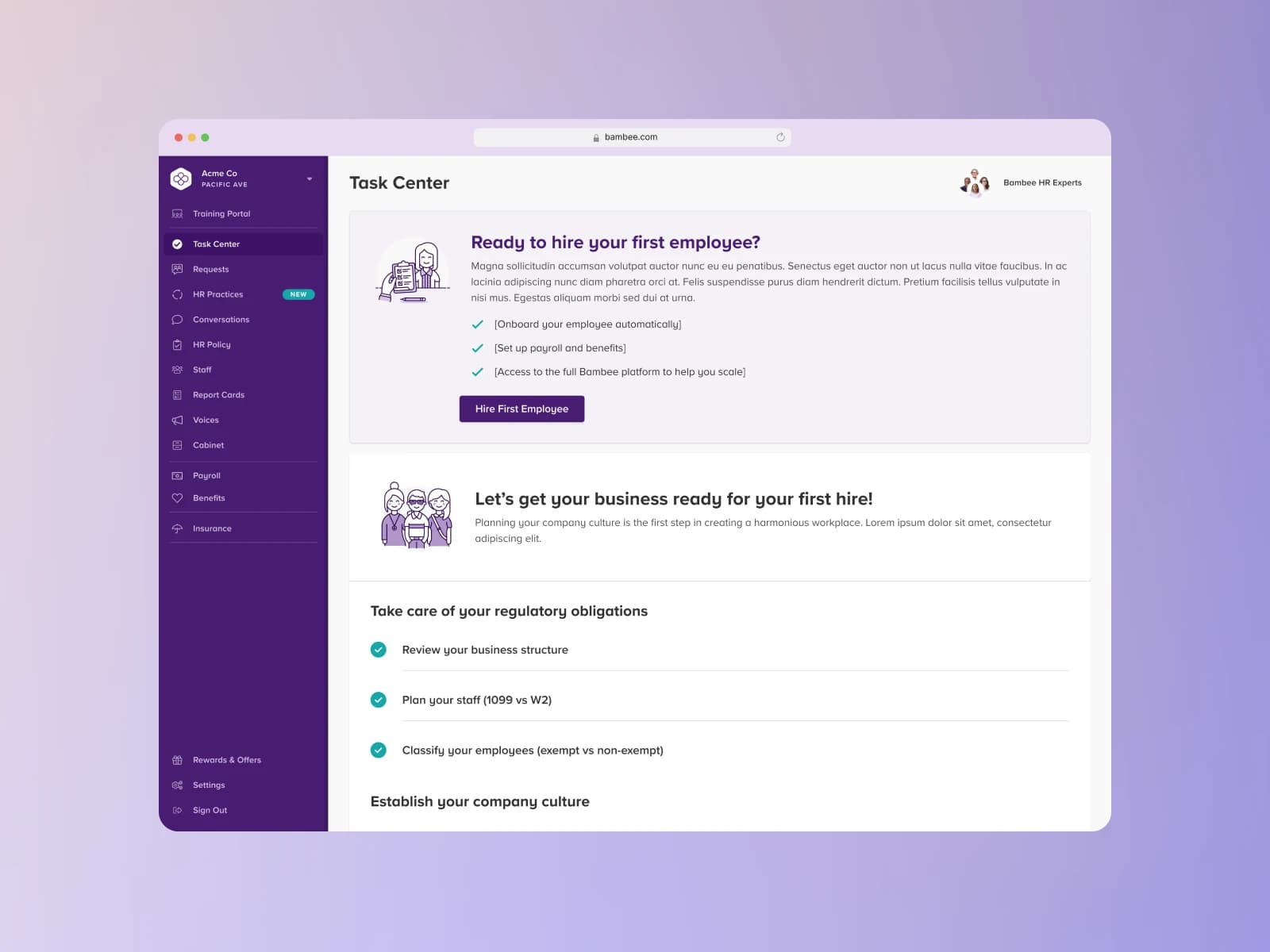
I rebuilt the acquisition funnel and shipped what customers asked for.
After the A, the job was compounding what worked. I rebuilt the funnel end to end: lead capture into qualification, the pricing moment, an audit-first entry point, and the landing pages for the radio traffic. The CEO voiced the radio spots himself, the pitch was the core claim, a dedicated HR manager for $99 a month, and the ads sent listeners to a dedicated landing page I designed for that traffic.
I also shipped the features customers kept asking for: e-signature, staff roster management, and training assignment. This was pre-AI engineering, everyone hand-coded everything, and every feature was a deliberate tradeoff, which made you careful about what was worth building at all. The company grew roughly 300% year over year in that stretch, a company number I don't pin to any one screen.
Honey: the internal tool where HR managers ran their accounts.
An HR manager might carry forty accounts, each a different small business with a different mess, and Honey was the internal tool where they ran all of it. The morning started in a queue: prioritized tasks across the whole book, unsigned policies, renewals coming due, open requests. Every client had a 360 view, each chat, call, and email on one timeline, so any HR manager could pick up a client cold. The high-stakes work ran as guided flows, terminations with state-specific steps. Policies moved through a pipeline from drafted to sent to chased-for-signature, and audits ran in the same tool.
Designing it meant holding two very different users in my head at once: the owner deciding whether to buy, and the HR manager grinding through the day. Those two people want opposite things from an interface, and I was the seam between them.
I ran design remotely through COVID.
The $15M Series B closed in the middle of COVID, and the company went remote overnight. By then I was managing two designers, and the job became keeping the product coherent while everyone worked from home: critique moved async into Figma comments, decisions shipped as recorded walkthroughs, and a standing design review kept the bar visible.
The work carried a different weight that year. Small businesses were in genuine distress, and the person on the other side of the screen was often deciding whether they could keep their staff employed that month.
I led design on payroll and time and attendance.
The $30M Series C in March 2022, led by QED Investors, brought total raised to about $65M with roughly 10,000 active subscribers, and it changed my job. I became Director of Product Design, half my time in Figma and half leading the team, and Bambee named Guided Payroll a headline investment of the round. That is the work I led: two regulated products, payroll on Check and time and attendance on Deputy.
Payroll is unforgiving. A wrong number costs a person rent. Building it for an owner with no payroll background, on top of a demanding third-party engine, came down to one approach I used three times: the HR manager handled the complicated parts in Honey, and the owner saw a simple, calm screen. Migration first: payroll data arrives however it arrives, a CSV, an email attachment, a Drive folder, and the intake had to accept the mess, self-serve but backed by the HR manager, who carried about half of them through the tricky cases. The hardest case, switching a client mid-year without breaking a W-2, we chose not to build at all; we onboarded at the start of a fiscal year and removed the risk. Then the partner seam: Check stayed fully white-labeled, the HR manager worked its full scope in Honey, and the owner saw a calm, simple state. Then tax and compliance, a genuine maze of multi-state registrations, which the HR manager configured for the owner the same way. By the time I left, about a thousand small businesses ran their payroll on it.
Bambee Lite signed owners up over chat.
Late in that era we built Bambee Lite, a chat-only signup. The flow asked an owner what a good account executive would have asked: headcount and states, the W-2 and 1099 mix, industry, what HR they already had in place, and what they wanted help with first. Pricing keyed off headcount tiers, so the owner saw a real price before any human appeared. The handoff went to their HR manager, and an account executive entered only on the edge cases. Most owners who finished the questions bought, which made it a high-margin funnel: the expensive part had been designed out, and the owner knew what it cost before committing.
Training attached at 40%, payroll at 10%.
Training plans, low-stakes and low-friction, attached at about 40%. Payroll and time and attendance, high-stakes and high-switching-cost, each sat around 10%. The value was obvious in every case; the difference was what an owner felt they were risking by turning it on.
So I stopped treating non-adoption as friction to nag away and started diagnosing the block. Owners paid for a dedicated HR manager and then would not call one, because saying an HR problem out loud is intimidating, so we moved the conversation to chat. Policies sat unsigned no matter how many reminders we sent, because in many of the workplaces we served a mandated signature carries little weight, a human dynamic no interface designs away, so we chipped at the friction with a mobile signing app and redefined the compliance bar to delivered-and-acknowledged. Training completion was never what the buyer paid for, so the business sold seats and stopped counting completions. The rule I carry: diagnose whether the block is friction, trust, or a human dynamic before you touch the button.
I won the design system's budget with customer evidence.
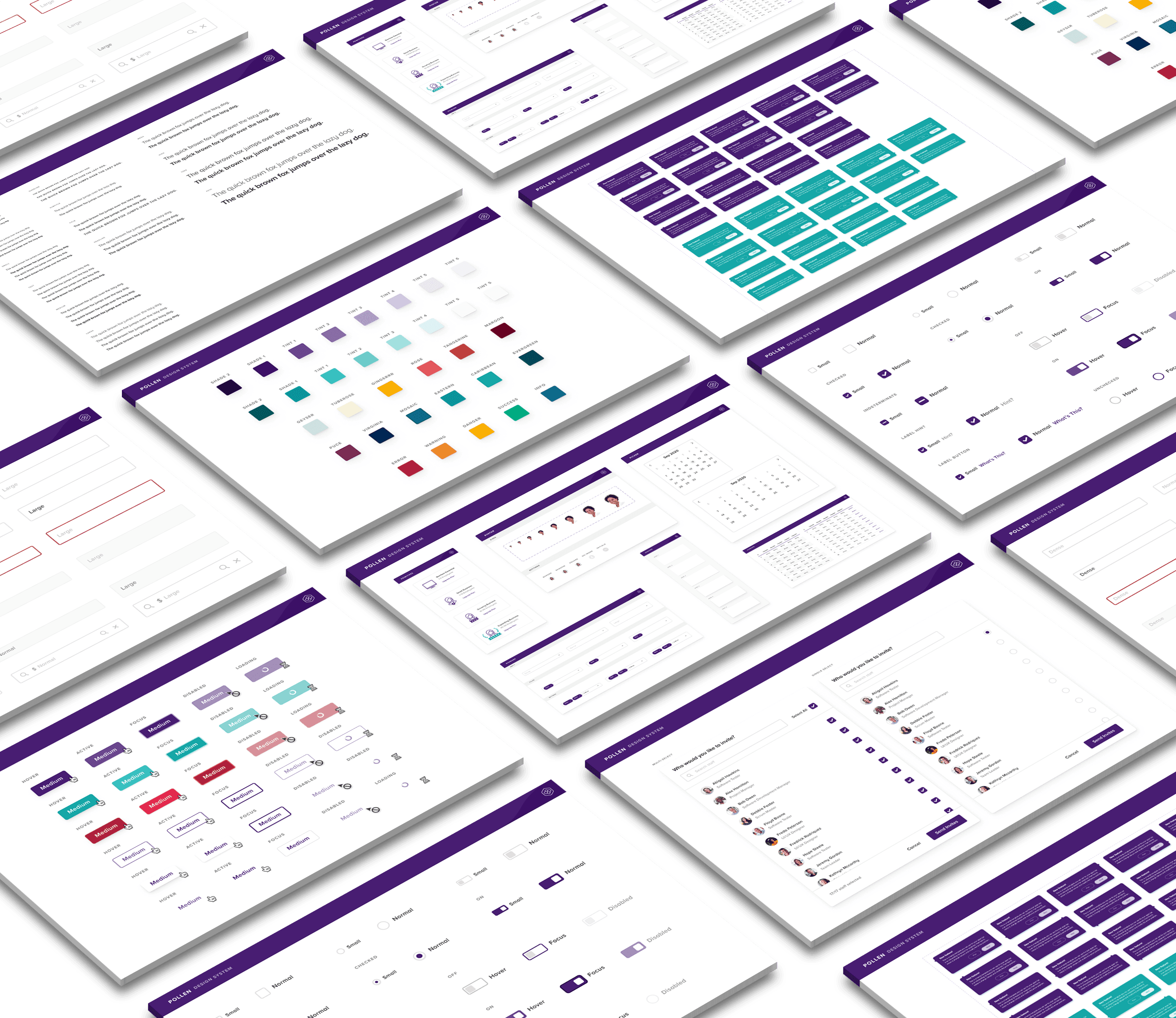
A design system is obvious to anyone who builds software and invisible to a growth CEO. To ours it read as pure cost, a real slice of the engineering budget for months with no visible payoff, so arguing the benefit was pointless. I made the cost of its absence concrete instead: I built Pollen in Figma first and demoed how fast I could produce screens with it, then brought a customer survey where UI and technical bugs came back as a real complaint, alongside an engineering org visibly slowing down without a shared system. That won the budget and a dedicated engineer to own the coded library.
In code, Pollen ran as a full B2B SaaS design system across both product lines, the customer platform and Honey, with a working governance loop: an engineer requested a component, design reviewed the request and designed it, and the engineering managers slotted the build so it was ready before production needed it. The name was the point, one system cross-pollinating consistency across every surface, and my reason for wanting it was practical. A system removes the routine decisions so judgment gets spent on the problem, the user, and the outcome. I don't want to reinvent foot coverings every morning; I want shoes.
Research was the other standing instrument, and how I earned the room to do good work. I ran NPS on the product and CSAT on HR-manager satisfaction, and sat with customers every quarter for hour-long interviews, close to four dozen deep conversations over the years. When I wanted to move the roadmap, I brought what customers actually said.
Ten thousand businesses, $18M ARR, $65M raised.
Bambee grew from five people to roughly 10,000 paying small businesses and about $65M raised across a Series A, B, and C, reaching on the order of $18M in annual recurring revenue at a nine-figure valuation. By the time I left in 2024, about a thousand of those businesses ran their payroll on the product I led. Those are company numbers, and I don't tie a single screen to any of them. What's mine is the work: the product, Honey, Pollen and the brand, the research, and the team I led through two regulated products.
Praise
David brought the mind of a founder to our product team. He'd take the ugliest cross-functional projects, the ones that had sat on a roadmap for two quarters, and come back in three weeks with a working prototype and a design the product team actually wanted to adopt. He raised the ceiling for what we thought was achievable on a given timeline.
Paul SterhellChief Product Officer, BambeePS